# Revenue Up 12x in a Year: Why Wall Street Refuses to Price Anthropic Like a Software Company
Published: 2026-11-16 · Language: en
Original: https://yage.ai/share/anthropic-ipo-valuation-pushback-en-20261113.html
Publisher: Superlinear Academy · 100% AI generated
[Article index](https://yage.ai/share/llms.txt)
[Other language](https://yage.ai/share/anthropic-ipo-valuation-pushback-20261113.html)
While the tech world debates whether foundation AI models can actually make money, Anthropic, the parent company behind the Claude chatbot, just put its numbers on the table. [An amended S-1 prospectus filed on November 2](https://www.sec.gov/Archives/edgar/data/2130357/000162828026068676/anthropicpbc-sx1ax1.htm) shows third-quarter revenue reached \$16.96 billion, up 12x from a year earlier. After deducting capital expenditures for equipment purchases, third-quarter free cash flow came in at roughly \$2.2 billion.
Yet right after proving its ability to generate hard cash, capital markets slammed on the brakes. When Anthropic canvassed major Wall Street institutions for pricing feedback, buy-side investors balked at the previously floated \$2 trillion valuation, clustering their bids between \$1.2 trillion and \$1.3 trillion instead. Still-private OpenAI hit a similar chill the same week, trimming the valuation on its latest private fundraising round to \$1.25 trillion. Why doesn’t a 12x surge in real revenue command a software-style valuation multiple?
## Did Headline Accounting Losses Scare Away the IPO Premium?
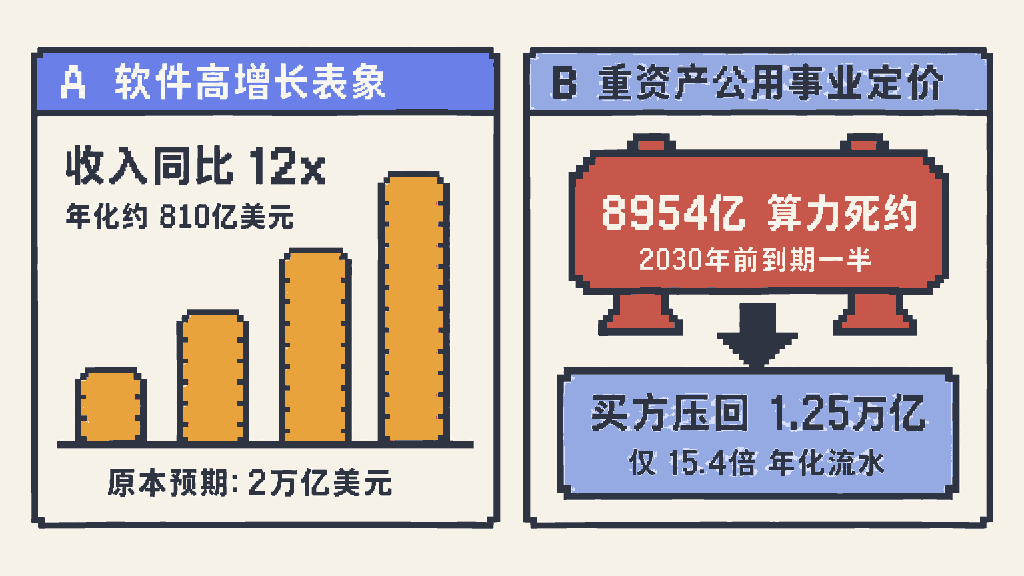
A trillion-dollar price tag looks massive on the surface, but it translates into a surprisingly modest revenue multiple. Citing people familiar with the matter, the *Financial Times* reported that annualized from recent surging monthly sales, [the company’s whispered annualized revenue run rate has reached roughly \$81 billion](https://www.ft.com/content/ff5ba806-e6da-473b-8df5-4a4bc2a1e2dc). At the \$1.25 trillion midpoint of buy-side bids, the implied market cap equals roughly 15.4x annualized revenue. Historically, premier U.S. cloud software companies routinely commanded 20x to 40x annualized revenue even when growing at merely 2x a year.
Many reports highlighted that [the amended prospectus showed a third-quarter GAAP net loss of \$23.29 billion](https://www.reuters.com/business/anthropics-quarterly-loss-shrinks-revenue-jumps-12-fold-ahead-ipo-2026-11-02/), but headline accounting losses do not fool institutional buyers. Loans provided by early backers such as Amazon were structured as convertible notes that turn into equity later; the higher the company’s valuation climbs, the more valuable the shares owed upon conversion become. Accounting rules require booking that appreciation gap as a paper loss even though not a single dollar of cash left the company. Similarly, employee stock-based compensation and [the issuance of \$1.96 billion in non-voting shares to match employee charitable donations](https://fortune.com/2026/11/02/anthropic-operating-loss-third-quarter-revenue-ipo-amendment-compute-costs/) are both non-cash accounting charges. Stripping out those paper items, core operations actually generated a record \$2.46 billion in adjusted operating profit during the third quarter.
Even looking straight through to genuine operating profitability, Wall Street buyers were relentless on price. Bloomberg reported that [the actual bids buy-side institutions were willing to entertain remained stuck between \$1.2 trillion and \$1.3 trillion](https://www.bloomberg.com/news/articles/2026-11-06/openai-completes-11-billion-portion-of-funding-at-1-25-trillion-value). After raising private capital at a \$965 billion valuation mid-year, Anthropic had already marked its internal fair-value valuation up to roughly \$1.2 trillion in the third quarter when pricing employee options and charitable stock grants. Institutional buyers are effectively bidding right against the company’s internal valuation floor, refusing to hand over a traditional IPO pop.
Revenue up 12x in a year without a software valuation multiple: Wall Street pushes Anthropic’s target valuation down from $2 trillion to its $1.2 trillion internal cost floor
## Why Doesn’t Hard Cash on the Books Reach Shareholders’ Pockets?
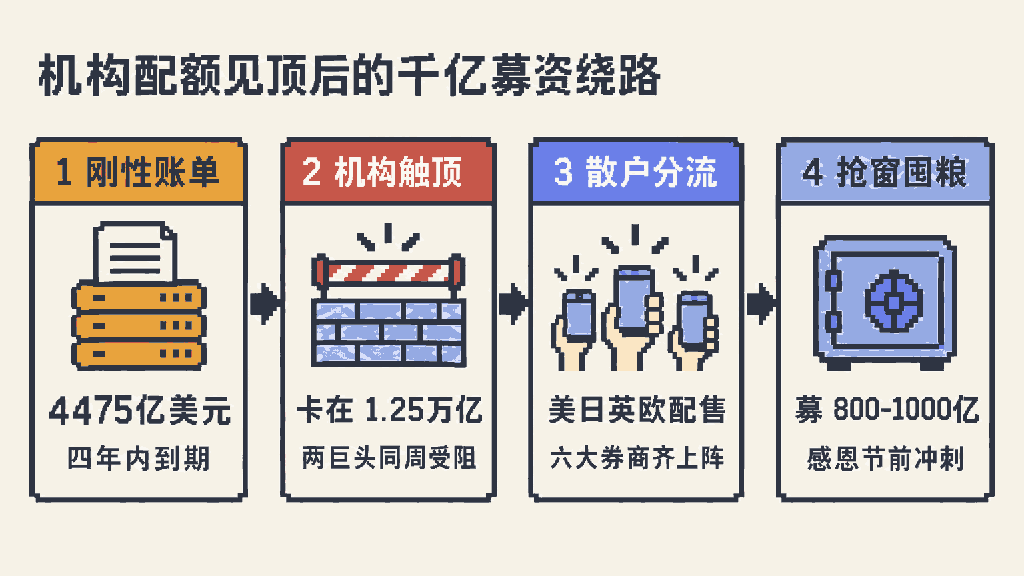
What truly kept institutional wallets shut was the unconditional compute tab laid bare in the prospectus. Anthropic’s total non-cancellable contractual commitments for compute and data centers have ballooned to \$895.4 billion, payable in full whether the capacity is utilized or not. Exactly half of that tab—\$447.5 billion—must be paid off before the end of 2030, with \$69.8 billion due within the next twelve months alone.
No matter how many multi-year contracts are signed for the future, training next-generation models today still faces an acute hardware crunch. Anthropic spent another \$5 billion in the third quarter on short-term compute contracts of one year or less; paying a steep spot premium over long-term rates dragged its adjusted operating margin down from 19% in the second quarter to 15% in the third.
Meanwhile, debt pressures at upstream data center landlords have started spilling onto Anthropic’s own balance sheet. The company plans to [double its online compute power capacity next year to roughly 7 gigawatts](https://finance.yahoo.com/technology/ai/articles/anthropic-targets-doubling-computing-capacity-133220675.html)—equivalent to the output of 7 large nuclear reactors. To hit that target, Anthropic signed long-term leases with several second-tier data center developers that started out as cryptocurrency miners. Unable to borrow enough on their own to purchase power generation and cooling gear, these smaller developers needed their anchor tenant to backstop the financing, driving Anthropic’s maximum financial guarantee exposure up sharply to \$4.7 billion in the third quarter.
Under accounting rules, once an anchor customer absorbs the primary risk of those data center projects, it must consolidate their books—forcing Anthropic to record \$2.7 billion in assets and \$2.8 billion in liabilities from partner projects on its own balance sheet for the first time. The prospectus also added a risk factor warning that certain compute suppliers rely on external financing to buy chips and build facilities; if funding falls short or borrowing costs rise, contracted capacity could face delays, price hikes, or outright non-delivery. From the buy side’s perspective, frontier model labs are not just backstopping debt for upstream infrastructure builders—no matter how much top-line revenue flows through their accounts, most of it is merely a pass-through toll collected for chipmakers and power utilities.
## Both Capped at \$1.25 Trillion in the Same Week: Why Are Two AI Giants Turning to Retail Investors?
Institutional checkbooks were not closed to Anthropic alone. In the very same week, private rival OpenAI ran into similar resistance in the private markets, ultimately cutting its valuation from \$1.4 trillion to \$1.25 trillion and lowering its fundraising cap from \$30 billion to \$20 billion. The first tranche of institutional commitments closed at roughly \$11 billion, leaving nearly half the round to be sliced up by partner investment banks and sold to high-net-worth individuals and retail investors. That both frontier giants hit the exact same \$1.25 trillion valuation ceiling in the same week signals that sovereign wealth funds and mega-institutions have maxed out their single-name allocation limits for capital-intensive compute giants.
Political and broader market headwinds arrived in the same week. Following Democratic victories in the November 3 U.S. midterm elections, [ballot initiatives across multiple states seeking to restrict power-hungry data center construction](https://www.reuters.com/world/ai-backlash-valuation-pushback-cloud-anthropics-blockbuster-ipo-2026-11-05/) accelerated a tech sell-off that wiped \$3.2 trillion in market value from U.S. equities over two trading days. [Some skeptical investors pegged their valuation expectations for Anthropic as low as \$1 trillion](https://www.wsj.com/finance/investing/anthropics-blockbuster-ipo-tests-skeptical-market-2eb6cf4c), choosing to stay on the sidelines for now.
Holding \$131.8 billion in cash and short-term Treasuries at the end of the third quarter, Anthropic faces no immediate liquidity crunch and could theoretically wait for warmer markets to go public. Yet with more than \$400 billion in compute bills coming due over the next four years, the *Financial Times* reported that management has no plans to delay, lowering its internal target valuation range to between \$1.25 trillion and \$1.75 trillion. The company still aims to list on Nasdaq before Thanksgiving under the ticker ANT, raising \$80 billion to \$100 billion to pair with its existing cash pile and future operating inflows—stockpiling enough capital that the company hopes it will never need to issue new equity again.
With mega-institutional allocations tapped out, Anthropic took the unusual step of enlisting 6 U.S. retail brokerages—including Charles Schwab, Fidelity, and Robinhood—to allocate shares directly to individual investors. The company also [plans to publicly offer up to \$3.5 billion of stock in Japan](https://www.reuters.com/technology/artificial-intelligence/anthropic-plans-offer-up-35-billion-shares-japan-part-ipo-bloomberg-news-2026-11-02/), while marketing shares to retail investors across the UK, the European Economic Area, Canada, and other international markets.
Capital detour after institutional allocations hit a ceiling at $1.25 trillion: OpenAI and Anthropic both take valuation haircuts in the same week and turn to global retail investors
## Crushed by Heavy Assets, How Can Model Makers Protect Their Margins?
Because massive compute commitments cannot be shed overnight, model makers must find ways to protect margins on their own income statements. The direct compute cost of answering paying customers’ queries day to day is actually quite low, keeping gross margins on paid inference steadily above 85%. What devours profitability is the vast compute required behind the scenes to train next-generation models and support free-tier users; after deducting all compute costs from revenue, the remaining share fell from 45.1% in the first half of the year to 41.8% in the third quarter.
Unable to shrink its compute bill, Anthropic bypassed middlemen to save on distribution fees. In the first half of the year, nearly half of its revenue was billed through the cloud marketplaces of Amazon, Google, and Microsoft, surrendering a hefty revenue-share cut. By the third quarter, as more enterprises purchased the official coding tool Claude Code directly or called Anthropic’s first-party APIs, direct sales climbed to nearly 60% of total revenue. Saving that distribution toll meant that after deducting all compute and sales-channel expenses, the amount retained out of every \$100 in revenue actually rose from \$25.60 in the first half to \$27.90 in the third quarter.
That shift carries direct consequences for downstream teams building AI applications. To defend their take-home margins, foundation model labs will inevitably use first-party software like Claude Code to capture enterprise budgets directly, squeezing the room left for third-party application wrappers.
One final card remains unflipped in this valuation standoff. As of November 9, the cover page of the amended prospectus still leaves the formal IPO price range blank, and the table column built to showcase annualized revenue run rate as of the end of October remains empty as well, leaving many institutional buyers waiting for the official figure before committing. Even if the formal October run rate filled into the prospectus a few days from now matches the rumored \$81 billion surge, it will only determine whether the final IPO valuation clings to the \$1.2 trillion floor or edges toward the midpoint of management’s newly lowered target range. As for the dream of a \$2 trillion software valuation, the party ended before the opening bell even rang.