# From Built-In Checkout Back to Filling Out Web Forms: Why OpenAI Gave AI a Credit Card
Published: 2026-11-19 · Language: en
Original: https://yage.ai/share/chatgpt-wallet-checkout-retreat-en-20261119.html
Publisher: Superlinear Academy · 100% AI generated
[Article index](https://yage.ai/share/llms.txt)
[Other language](https://yage.ai/share/chatgpt-wallet-checkout-retreat-20261119.html)
Many people already rely on ChatGPT to research purchases—comparing specs, weighing options, and narrowing down choices—yet still open the retailer’s website to enter their card details themselves. Handing a real credit card number directly to an AI is simply too risky: if the agent misreads an item and buys the wrong thing, or accidentally leaks the number, the user takes the financial hit.
On November 13, 2026, OpenAI [officially launched ChatGPT Wallet](https://openai.com/index/introducing-chatgpt-wallet/) in partnership with Visa, Mastercard, American Express, and Chase, giving its newly released personal agent a way to pay. A little over a month earlier, OpenAI had introduced `dot`, an always-on personal cloud agent inside ChatGPT that operates on an isolated cloud computer and cloud browser.
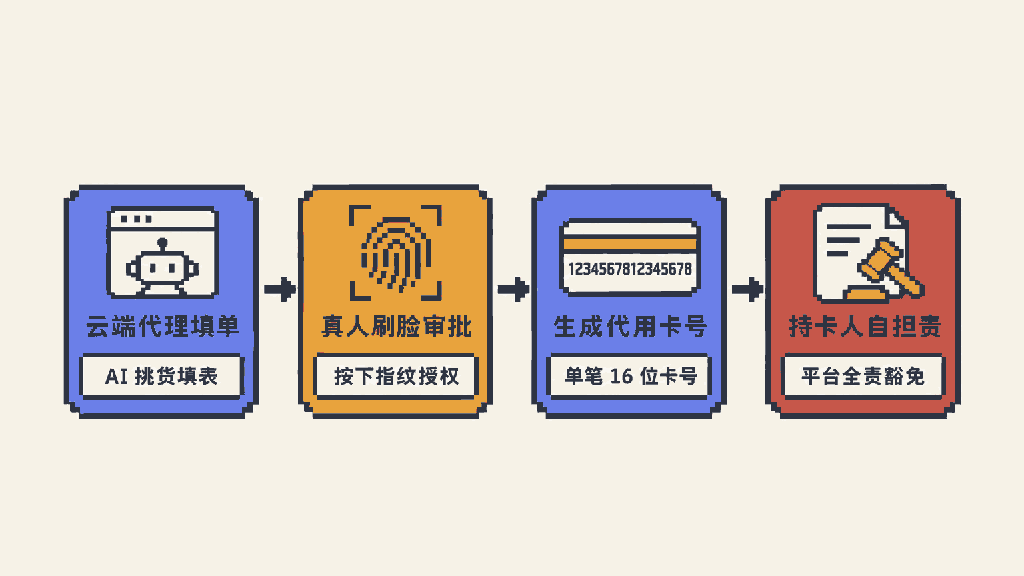
With ChatGPT Wallet, you link your credit card once in settings, and `dot` can then browse a merchant’s website in its cloud browser, select items, and fill in your shipping address. Right before payment, `dot` pauses and pops up a confirmation prompt asking you to review the merchant name, item, and total price, then approve the purchase via Face ID, Touch ID, or another biometric check on your phone or computer. On the spot, the card network generates a substitute card number, security code, and expiration date valid only for that single transaction—a single-use tokenized card—and hands it to `dot` to type into the merchant’s checkout form and complete the purchase.
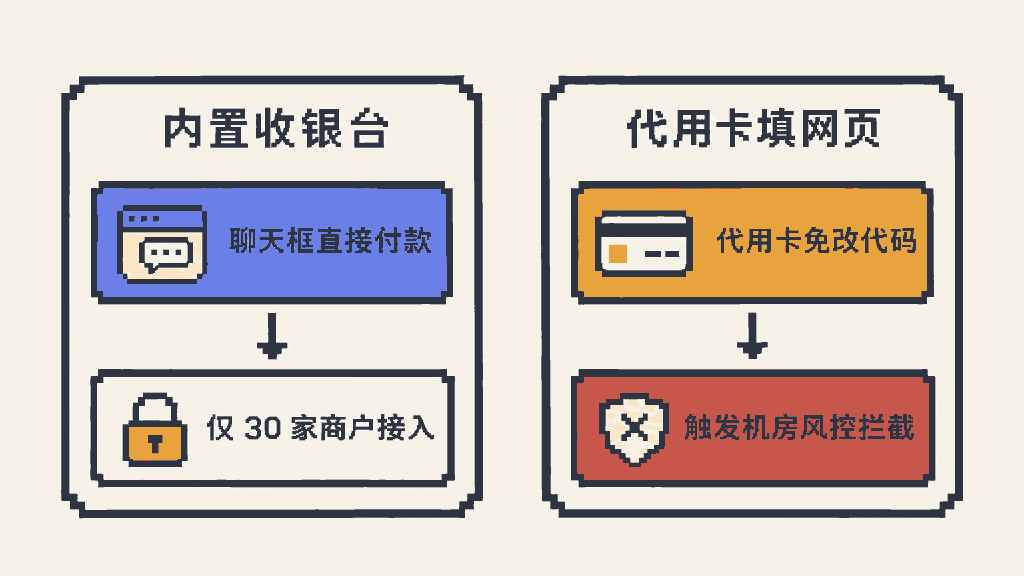
On the surface, OpenAI has finally closed the loop on agentic shopping payments, but it actually reversed course to get here. Previously, OpenAI wanted users to shop and pay without leaving the chat window; now, the AI goes out to the merchant’s actual website and pays on the merchant’s own checkout page. After its push 14 months ago to move the cash register inside the chat box ran into a wall, this is a strategic retreat. Paying on merchant websites, however, introduces three new hurdles: fraud controls, legal liability, and merchants locking the door altogether.
## Why Not Let Users Pay Directly in the Chat Window?
ChatGPT has 1.2 billion weekly users and nearly 100 million paying subscribers. Since people are already asking what to buy inside the chat window, wouldn’t the smoothest design be a buy button right inside the conversation? Last September, OpenAI tried exactly that. Partnering with Stripe, it [launched Instant Checkout inside the chat interface](https://openai.com/index/buy-it-in-chatgpt/), letting users pay without leaving the thread while OpenAI took a commission from merchants on each sale. At the time, OpenAI prominently previewed plans to onboard more than 1 million Shopify stores.
Six months later, however, that built-in checkout was quietly shut down this March, with OpenAI announcing a shift back to product discovery and price comparison. As CNBC reported, [data from research firm Forrester showed](https://www.cnbc.com/2026/03/20/open-ai-agentic-shopping-etsy-shopify-walmart-amazon.html) that out of the million Shopify merchants initially promised, only about 30 had actually gone live half a year later. Merchants did the math: when checkout happens inside a chat window, the retailer only receives a bare order after payment, losing early browsing behavior data and any chance to recommend add-on items before checkout. Even more damaging was conversion. Walmart’s own testing found that selling directly inside ChatGPT produced a purchase conversion rate two-thirds lower than sending shoppers back to the retailer’s own site to check out.
Merchants weren’t the only ones holding back—consumers haven’t built the habit of letting AI place orders for them either. This fall, Meta’s personal shopping assistant Muse topped the US App Store charts with over 10 million downloads. Yet on [a recent Q3 earnings call](https://www.trendingtopics.eu/uber-airbnb-doordash-booking-ai-agents-are-barely-booking-anything-so-far/), Uber’s CFO offered a sobering figure: during Halloween week, the busiest week of the year, out of roughly 320 million ride and delivery orders across the platform, AI assistants booked only 4 rides in total and around 500 food delivery orders.
Other consumer platforms tell a similar story. Out of DoorDash’s roughly 3 million daily deliveries, third-party AI assistants account for only a few hundred orders in total; on Airbnb and Booking, the share is negligible as well. The reason is straightforward: calling a car yourself in a mobile app takes an average of 50 seconds, and reordering a go-to meal takes a minute and a half. People are happy to let AI research and compare options, but when it comes time to pay, tapping the button themselves still feels easier.
## If Merchants Don’t Have to Change Code, Where Did the Cost Go?
Since merchants refused to rewrite their code to move checkout into the chat box, OpenAI flipped the approach. Its head of monetization [confirmed to CNBC](https://www.cnbc.com/2026/11/13/openai-chatgpt-wallet-dot-purchases.html) that ChatGPT Wallet charges no transaction fees at launch. Technically, it no longer asks merchants to integrate a new checkout API; instead, `dot` takes a single-use tokenized card issued by the card network and fills out the credit card form already sitting on the merchant’s webpage, just like a human shopper. In its accompanying [Merchant Playbook payment guide](https://developers.openai.com/commerce/guides/accept-payments), OpenAI states plainly that existing merchant checkout pages work out of the box, requiring no custom code changes for the wallet.
Even if merchants don’t have to touch their checkout code, the moment a payment request goes out, it runs straight into merchant fraud-detection systems. Why would a legitimate tokenized card freshly issued by a card network get declined? Because `dot` isn’t clicking buttons from your phone at home—it is operating a cloud browser on a cloud computer inside OpenAI’s data centers. To e-commerce fraud engines like Forter, Riskified, Sardine, and Signifyd, thousands of orders pouring in from the same cluster of data-center IP addresses, using browsers with no ordinary browsing history, look identical to hackers running automated scripts to test stolen cards. Fraud systems are built to block that pattern on sight.
To address this, OpenAI explicitly notes in its Merchant Playbook that this cloud-based browser can inadvertently trigger merchant fraud controls and cause payments to fail. Its workaround is a way for merchants to recognize the cryptographic digital signature of ChatGPT’s official browser inside firewalls such as Cloudflare. OpenAI also attaches a `Forwarded` header to the network requests its cloud browser sends to merchants, passing along signals about the human behind the session—such as their broadband network range, country, and time zone—to help fraud systems assess risk. Alongside this, OpenAI worked with payment processors like Stripe and Adyen and the four major fraud-prevention firms to adjust their detection rules. So while OpenAI pitches zero front-end code changes for merchants, the broader e-commerce stack still has to rework its back-end firewall and fraud-allowlisting logic.
Built-in checkout stalled because merchants refused to give up their checkout pages; filling forms with single-use tokenized cards avoids code changes but runs into data-center fraud blocks.
## Why You Have to Scan Your Face or Fingerprint for Every Purchase
If card networks can already generate single-use tokenized card numbers restricted to one transaction, why doesn’t OpenAI let `dot` buy things autonomously in the background instead of pausing every time for a face scan or fingerprint? Reading the [official ChatGPT Wallet help documentation](https://help.openai.com/en/articles/20001654-making-purchases-with-chatgpt-wallet) also reveals strict initial guardrails: access is limited to adult US Pro subscribers on the \$200/month plan; users cannot link virtual cards from other platforms as funding sources, preventing a tokenized card from being layered on top of a virtual card and breaking the accountability chain; and linking a Chase card requires being the primary cardholder rather than an authorized user, with biometric approval completed inside the Chase mobile app.
Beyond stopping hackers, the real reason for these thick layers of protection sits in the newly effective [ChatGPT Wallet Terms of Service](https://openai.com/policies/chatgpt-wallet-terms/). If an AI buys the wrong size or books a non-refundable discount flight without human confirmation, who eats the cost? OpenAI spells it out directly in the terms: AI systems can make mistakes, so you must carefully verify the merchant, item, and total price before tapping approve; once you approve, you are legally the one placing that order with the merchant. In the disclaimer section that follows, OpenAI states explicitly that the merchant is the sole legal seller of record, that OpenAI neither decides nor funds any merchant refunds or chargebacks, and emphasizes in all caps that it bears no legal liability for any purchase, fulfillment, or dispute arising from the wallet.
This design draws a sharp line around liability. The question that has stalled the whole industry—who pays when an AI misreads a page and buys the wrong item—gets resolved by requiring biometric sign-off before payment. Once you press your fingerprint, both the law and the banking system treat the transaction not as autonomous AI spending, but as a cardholder-authorized purchase. Your existing credit card rewards, cash back, and chargeback protections for defective goods remain intact, while the risk of buying the wrong item by mistake falls squarely on you, the person who approved it.
Human biometric approval triggers the generation of a single-use tokenized card number while keeping order verification and post-purchase dispute liability between the cardholder and the merchant.
## What If Merchants Won’t Even Let the Agent Through the Door?
Even with card networks, fraud-prevention firms, and liability waivers lined up, one unavoidable obstacle remains: merchants that simply do not want AI agents shopping on behalf of human customers. Even before ChatGPT Wallet launched, Amazon had already blocked external shopping assistants because AI doesn’t view on-site ads or click product recommendations. Two days before ChatGPT Wallet debuted, merchants escalated their defenses further. On November 11, [United Airlines issued an announcement](https://www.united.com/en/us/newsroom/announcements/cision-125496) updating its website terms to ban any unauthorized third-party AI agent from searching fares, booking tickets, or checking in. United’s language reads like a direct strike against OpenAI’s model: it stipulates that using an automated agent constitutes a breach regardless of whether a human is supervising or approving every single transaction. It even added a non-waiver clause stating that if United’s technical defenses fail to block an agent—and the airline collects payment and issues a ticket—it still reserves the right to cancel the ticket afterward and pursue remedies.
When faced with merchants that refuse to open the door, OpenAI’s official documentation quietly lays out two paths. One is the merchant-facing Merchant Playbook, which politely encourages retailers to claim their newly launched ChatGPT merchant profile, upload product catalogs, and allowlist the cloud browser in their firewalls. The other is the consumer-facing [`dot` getting-started help documentation](https://help.openai.com/en/articles/20001530-getting-started-with-your-dot), which quietly points to a back door: if a site blocks the cloud browser, you can enable local computer access in the desktop client so `dot` can borrow your own local browser to visit the site. Courting cooperation at the front door while showing users how to slip around the back proves that issuing a compliant tokenized card alone isn’t enough to make powerful merchants welcome agents in.
Notably, on the very same day ChatGPT Wallet launched, Brave announced a new capability for its search API allowing AI agents to call search without creating an account, attaching \$0.005 in on-chain stablecoins directly to each web request—instant payment in exchange for results. That mechanism is built on the increasingly popular [x402 protocol](https://brave.com/blog/search-api-agentic-payments/). Yet Brave’s open-source gateway documentation also notes that it had to remove the autocomplete and spellcheck endpoints because their per-query prices were lower than the on-chain settlement fee.
Two announcements on the same day drew a clear boundary around how AI spends money: when machines buy half-cent slices of data from other machines in the background, account-free, irreversible micropayments make sense; when machines buy hundreds of dollars’ worth of flights or sneakers on behalf of humans, there is no room for unrecoverable mistakes, so the system falls back on traditional card networks and anchors liability with a human face scan or fingerprint on every purchase. After 14 months of iteration, OpenAI finally used single-use tokenized cards to solve how to hand a card safely to the register. Yet as long as merchants worry about losing direct customer traffic and humans still have to backstop every order themselves, the day you can truly hand off online shopping to an AI remains a long way off.