# $5 AI Hackers Are Here: Why Being "Too Small to Target" No Longer Keeps You Safe
Published: 2026-11-25 · Language: en
Original: https://yage.ai/share/five-dollar-ai-hackers-en-20261125.html
Publisher: Superlinear Academy · 100% AI generated
[Article index](https://yage.ai/share/llms.txt)
[Other language](https://yage.ai/share/five-dollar-ai-hackers-20261125.html)
When you run a personal project, an indie product, or a small team’s service, it is easy to carry a quiet sense of security: this is just a small site with little user data and barely any money on the books—why would a hacker waste time on me?
For the past decade or more, that instinct mostly held up. Security folks call it security through obscurity. Launching a targeted intrusion used to take a skilled attacker days of reconnaissance, code reading, and scripting. With labor costs that high, breaking into a low-value small site wouldn’t even pay for the hours spent. Big companies were the real targets; as long as a small project didn’t set its database password to `123456`, it could usually get by untouched.
In the fall of 2026, several security teams stumbled upon a wave of attacker control panels left exposed without passwords, revealing a new reality: that invisible shield is gone. Using open-source AI tools, attackers have pushed the cost of an automated intrusion down to \$5–\$25 per target. Even if your website itself is worth nothing, the LLM API keys and local compute sitting on your server have become liquid currency on their own.
## Why a \$5 Amateur Crew Now Goes After Targets Nobody Used to Touch
To see why small projects are no longer safe, it helps to look at what today’s AI attack tools actually are.
Over the past six months, roughly 45 open-source AI automated penetration-testing tools have appeared on GitHub, led by ARTEX, Cairn, and PentAGI, with the top five racking up more than 60,000 stars combined. These tools wrap over a hundred traditional hacking utilities into interfaces that large language models can call directly. Feed in a target URL, and multiple sub-agents automatically loop through scanning, vulnerability discovery, exploit scripting, and intrusion attempts. The author of ARTEX took down the GitHub repository in early October, but by then there were already more than 12,000 forks—the takedown did nothing to stop its spread. In a [November 13 advisory](https://www.ic3.gov/CSA/2026/261113.pdf), the FBI noted that more than 1,600 ARTEX consoles were exposed on the public internet alone.
Are these tools actually smart? Not at all. Security firm NorForge inspected more than 20 exposed malicious Cairn panels covering over 1,100 real attack projects and calculated the true hit rate in its [investigation](https://norforge.com/blog/inside_cairn): the average success rate was only about 10%, and even the successful intrusions took nearly 23 hours on average.
The real backend logs are full of amateurish blunders. Cloud security firm Wiz observed in its [tracking analysis](https://www.wiz.io/blog/artex-in-the-wild-storm-0940-expands-targeting-of-it-and-software-vendors) that ARTEX fired over 60 basic unsigned token attempts at Microsoft’s heavily hardened login endpoints within two minutes—like swiping an unstamped fake badge 60 times in a row. Even more absurd was an incident documented by Gambit Security in its [report](https://gambit.security/blog-posts/autonomous-ai-agents-online-retailers-25-a-company): an attacker chained three open-source tools to scan 105 online commercial sites over five days, compromising at least 27 companies and stealing more than 600,000 unexpired credit card records. Yet after breaking into a bicycle retailer, the AI agent ran a cleanup script with overly broad wildcards and wiped 180 database tables, including the backups. Even the attackers’ own operations were sloppy: many left their panels completely unauthenticated, only to be hijacked by rival hackers who stole their keys.
Wiz stated plainly that these tools have not invented any new techniques. Every target they broke into fell to classic hygiene gaps: weak passwords, leaked credentials, and unpatched legacy plugins.
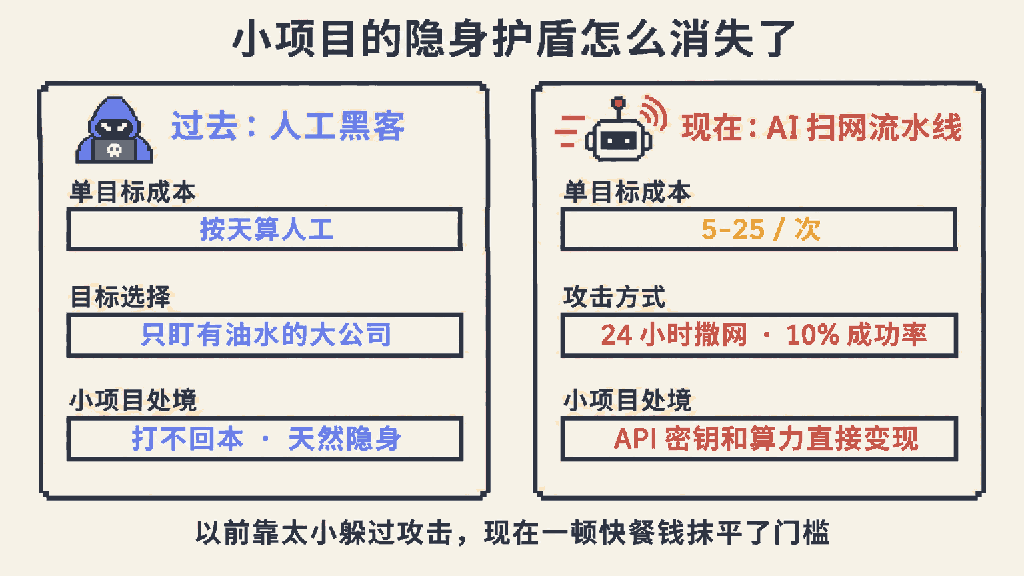
So why does such a clumsy operation with a 10% success rate make small teams more vulnerable than before? Do the math. NorForge estimated that running a Cairn automated attack with cheap models costs only about \$5 on average; Gambit calculated that the backend behind the 27-company breach spent an average of just \$25.46 per target. Hiring a skilled human hacker to work on a mid-sized site used to be billed by the day and rarely paid off. Once the price of a single attempt drops to the cost of a fast-food meal, machines can cast nets 24 hours a day. Attackers don’t need to succeed every time—landing 1 out of 10 targets is enough to turn a steady profit. The cost barrier that used to protect small websites has been wiped out for the price of lunch.
How the obscurity shield for small projects vanished: human hackers billed by the day and focused on large enterprises, whereas a $5–$25 AI pipeline runs 24/7 and profits even at a 10% success rate
## Your Project Has No Money, but Your API Keys Can Fund the Attack Machine
At this point, many solo developers might think: I only run a tech blog, an open-source demo, or an internal utility with no credit cards and no paying customers—what could a hacker possibly get for spending \$5 on me?
The answer is sitting in your environment variables and local services. In 2026, LLM compute and API quotas have become prime assets in their own right.
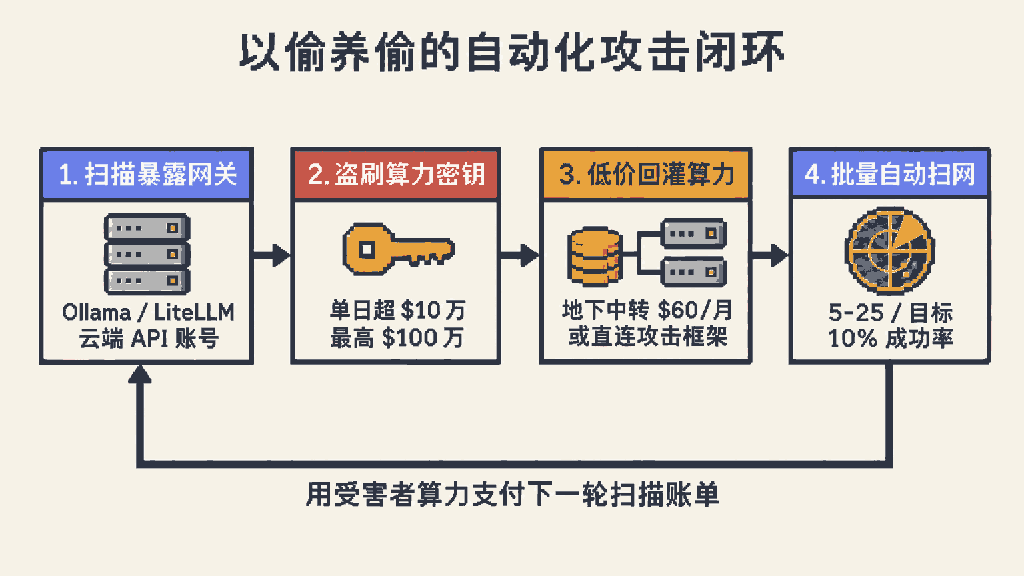
In a November [dedicated tracking report](https://cloud.google.com/blog/topics/threat-intelligence/llmjacking-monetizing-compromised-cloud-models), Google detailed how hijacking enterprise cloud LLM quotas has matured into an underground supply chain. Once attackers obtain a cloud account through leaked keys or phishing, they immediately enable LLM APIs or spin up high-end GPUs, racking up over \$100,000 in a single day—and up to \$1 million cumulatively in the worst cases before victims notice. Those stolen quotas flow into underground proxy markets, where some platforms sell “unlimited” frontier-model plans for as little as \$60 a month.
After the summer of 2026, attackers stopped merely reselling stolen compute and started feeding it straight into their own attack agents. In June, security firm Sysdig first observed attackers wiring unauthenticated, internet-exposed Ollama instances directly into automated scanning pipelines. That fall, [Amazon’s threat intelligence honeypots](https://aws.amazon.com/blogs/security/amazon-threat-intelligence-observes-threat-actors-running-cybercrime-campaigns-with-artex-ai-agents/) caught ARTEX completing the loop: it scanned for publicly exposed model proxies like One API, LiteLLM, and Ollama, tested the stolen API keys for quotas, and fed them right back into its own configuration to pay for the next wave of scans.
Many developers spin up Ollama or a model proxy on a test VPS or home server for convenience, expose the port publicly without a password, or accidentally leave test API keys in a public repository. To an attacker, that box is a free mining rig—even if it holds zero business data.
You might wonder: don’t major model providers have safety guardrails that refuse to write attack code? In practice, those guardrails barely slow down open-source offensive tools. In its November 13 [source-code audit](https://www.elastic.co/security-labs/threat-command/agentic-offensive-frameworks-detection-artex) of five popular frameworks, Elastic found that none checked whether the user had authorization, and several built in explicit refusal-bypass logic—Cairn, for example, pauses for 5 seconds when a model refuses and automatically switches to another model. The FBI advisory also noted that active ARTEX instances primarily rely on low-cost, lightly guarded DeepSeek Flash models. Meanwhile, open-weight models can have their safety guardrails stripped on a regular laptop in under 10 minutes. Provider bans and model guardrails alone can no longer contain these self-funding machines.
Self-funding automated attack loop: open-source offensive frameworks scan exposed AI gateways and cloud accounts, steal API keys, and feed them through underground relays or back into themselves to power $5–$25 batch scans
## From Installing Plugins to Writing Code: Two New Entry Points Close to Everyday Developers
Even if you keep your model services locked inside a private network and simply run a website with open-source plugins or use AI coding assistants at work, two new shifts in the fall of 2026 hit right at everyday developer habits.
The first shift is that once an open-source project releases a security patch, your grace period to upgrade has almost vanished. Previously, when a WordPress plugin or open-source library pushed an update, most people waited a week or two until they had time, assuming attackers needed days to figure out how to exploit it. In its November 16 [quarterly threat report](https://cloud.google.com/blog/topics/threat-intelligence/agentic-threat-activity-crosses-a-significant-threshold), Google disclosed a Russian-language pilot program dubbed `exploit_agent` found on an exposed staging server. It continuously monitored popular open-source web software: the moment a patch dropped, it pulled the before-and-after code, used LLMs to identify the fixed flaw, wrote an exploit script, and launched attacks against unpatched sites with no human in the loop.
There is no need to mythologize that single tool. Its own configuration file carried a Russian comment labeling it a pilot project, the code snippet shown in the report only inspected a simple URL-matching check in the Spectra WordPress plugin, and an [independent review](https://labs.cloudsecurityalliance.org/research/csa-research-note-gtig-autonomous-exploit-pipelines-20261119/) by the Cloud Security Alliance noted that Google published no success rate for it. Still, the approach has already worked in the wild: when PaperCut print management software disclosed vulnerabilities in late August 2026, GreyNoise [documented](https://www.greynoise.io/blog/ai-orchestrated-campaign-against-papercut-ng-mf) an attacker using OpenAI’s Codex harness to drive a DeepSeek model, going from scratch to a working patch-diff exploit in just 70 minutes, compromising the first real server in under 4 hours, and hitting 440 systems across 395 organizations in two days. Security patches themselves are becoming the starting gun for automated scanning.
The second shift lives inside the local development environment you open every day. In the same quarterly report, Google noted that the North Korean threat group MIDNIGHT NEPTUNE broke into internal code repositories at cryptocurrency firms in North America and Europe and, instead of touching application code, quietly modified `.claude/settings.json`. Whenever a teammate launched Claude Code in that repo, the configuration hook automatically downloaded a backdoor. This finding currently comes from Google as a single source without full technical indicators, yet what makes it tricky is that it exploits no software bug at all—only a team’s default trust in repository configuration files.
## Four Gaps Small Teams and Solo Developers Can Close Today
Solo developers and small teams cannot staff a 24/7 security operations center, and there is no need to panic. Today’s automated attack tools remain crude, succeed only about 10% of the time, and mostly pick off basic hygiene gaps. Spending half an hour closing the four gaps below will stop the vast majority of \$5 scanning bots.
Lock down self-hosted AI services and set spending limits on every API key. Check your cloud servers and tunnel configurations right now to make sure Ollama, LiteLLM, One API, or any custom model proxy is not exposed publicly without authentication. In your model provider dashboards, set hard monthly spending caps on every API key, and prefer short-lived, least-privilege credentials over long-lived static keys so one leaked test project cannot turn into a runaway compute bill.
Hide admin panels and put a web application firewall in front of public entry points. Even in the PaperCut campaign where attackers built a working exploit in 70 minutes, targets protected by Cloudflare’s WAF blocked the attack outright. Move admin dashboards and legacy plugin endpoints behind a private network or VPN; for sites that must stay public, put a basic WAF in front so temporary rules can block template-driven bots while you schedule upgrades.
Treat AI tool configuration files in repositories as executable code. Files like `.claude/settings.json` and `.cursorrules` can now dictate what commands an AI assistant runs on your machine, so review changes to them with the same rigor as CI/CD build scripts. When cloning unfamiliar open-source repositories, avoid turning on blanket auto-approval for command execution just for convenience.
Finally, keep offline or read-only backups for anything that matters. Traditional security focused on preventing data theft or ransomware, but automated agents add a more absurd hazard: a clumsy cleanup script wiping 180 tables along with your online backups. Separating backup permissions from your live database beats regretting it later.
The era of small projects staying safe simply because they were too small to bother with is over. The good news is that 24/7 scanning machines always go after the easiest targets first. You do not need an impenetrable fortress—just put two more locks on your door than the unguarded servers next to you, and the \$5 pipeline will move right along to the next IP.