# Why You Must Start Learning Graph Engineering Right Now
Published: 2026-07-23 · Language: en
Original: https://yage.ai/share/why-you-must-care-about-graph-engineering-en-20260723.html
Publisher: Superlinear Academy · 100% AI generated
[Article index](https://yage.ai/share/llms.txt)
[Other language](https://yage.ai/share/why-you-must-care-about-graph-engineering-20260723.html)
> Target Audience: Tech practitioners and system designers seeking to see through the AI Agent hype and avoid architecture overkill.
You indeed must start learning **Graph Engineering** right now.
However, the reason to learn it is certainly not because the underlying technology has broken through any unbelievable new frontier, nor because you will be obsolete if you do not master Graph structures. On the contrary, you need to learn it because everything that transpired around it in just 5 days—from July 17 to July 22, 2026—provides a textbook case study for deconstructing how tech buzzwords are manufactured.
Understanding this 72-hour narrative wave clarifies how the industry repackaged graph theory basics and mature engineering components. It reveals how community bloggers, consulting agencies, and infrastructure vendors injected their own agendas into the exact same blank term. The single greatest value of this exercise is building immunity against future tech hype cycles, allowing you to rediscover true engineering common sense amid deafening marketing noise.
------------------------------------------------------------------------
## Technical Reality: 0% Low-Level Innovation and Big Tech Restraint
If you strip away all the marketing buzzwords, Graph Engineering introduces zero new compute models or low-level primitives.
In the Prompt era, the industry witnessed a naming progression from Chain of Thought to Tree of Thoughts, and then to Graph of Thoughts. In the Agent era, the exact same script replayed: moving from single calls to iterative Loops, and then logically proclaiming Graph structures. Yet in computer science and graph theory, a chain is a specialized tree, a tree is a special case of a Directed Acyclic Graph (DAG), and a loop with a feedback cycle is simply a graph. Introducing graph structures into code control flow is hardly an invention. As early as 2014, Apache Airflow ([Airflow](https://airflow.apache.org/docs/apache-airflow/stable/project.html)) was using DAGs for task orchestration; Temporal ([Temporal Workflows](https://docs.temporal.io/workflow-execution)) has long managed complex distributed workflows via state machines. In Agent systems, using graphs to organize code logic contains zero technical innovation.
In contrast to the hype, mature engineering teams have remained remarkably restrained in their terminology. In their December 2024 engineering report [Building Effective Agents](https://www.anthropic.com/engineering/building-effective-agents), Anthropic documented routing, parallelization, orchestrator-workers, and evaluator-optimizer topologies, plainly calling them Workflows. Even in May 2026, when Claude Code introduced multi-agent concurrency and automated scheduling ([Claude Code Documentation](https://docs.anthropic.com)), Anthropic officially named it **Dynamic Workflows**, avoiding speculative buzzwords. Their June 2025 report on [How we built our multi-agent research system](https://www.anthropic.com/engineering/multi-agent-research-system) similarly categorized the architecture as an orchestrator-worker workflow system rather than a new paradigm.
The reality is straightforward: the industry has long possessed these engineering tools, and mature teams have always used these structures. So why did this term explode in July 2026?
The spark was simply a 12-word social media post with zero technical specifications. On July 17, 2026, developer Peter Steinberger (`@steipete`, founder of PSPDFKit and author of OpenClaw) posted on X:
> *“Are we still talking loops or did we shift to graphs yet?”*\
> ([Original Post](https://x.com/steipete/status/2078277297791189132))
This was merely a humorous observation on tech buzzword cycles. Peter gave no technical definition, wrote no code, drew no architecture diagram, and did not even coin the term Graph Engineering. Yet because the post lacked concrete specifications or code, it acted as a blank slate—a perfect projection screen upon which everyone could project their own commercial interests, products, and agendas without being contradicted by the original author.
------------------------------------------------------------------------
## Community Projection: Four Distinct Injected Agendas
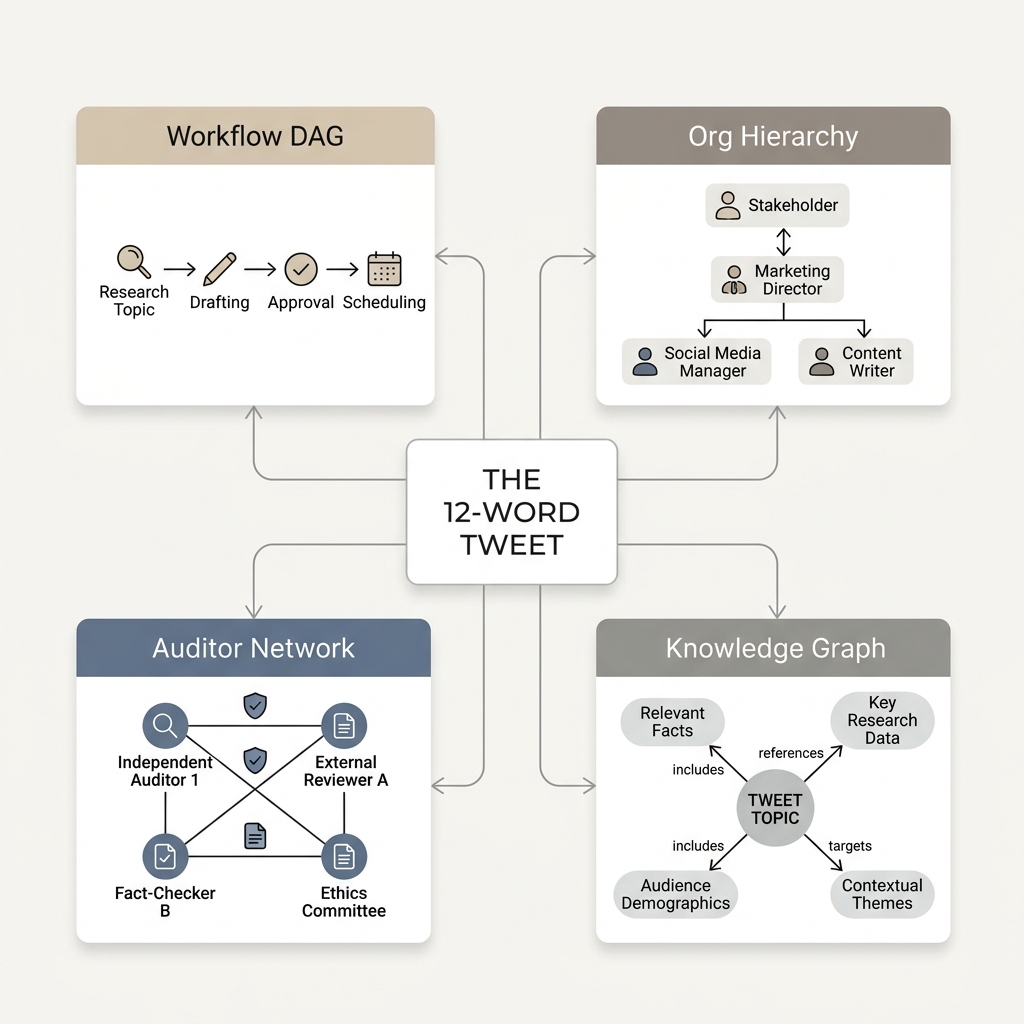
Community Projections and Agenda Injections Around Peter Steinberger’s 12-Word Tweet
In the 72 hours following Peter’s post, diverse community actors rushed in. Since the original tweet lacked a concrete definition, everyone interpreted it according to their own goals, forcing four distinct and conflicting concepts into the same empty vessel:
- **Agenda 1: Control Flow Advocates Repackage Workflows as a New Paradigm**\
Open-source developers and content platforms (such as [ExplainX](https://explainx.ai), [Data Science Dojo](https://datasciencedojo.com), [The AI Operator](https://theaioperator.io), and [Daily.dev](https://daily.dev)) took the lead. They defined Graph as a topological network solving multi-task routing, conditional branching, fan-out/fan-in parallel dispatch, and handoffs between nodes. In their view, single-agent loops tend to drift during long sequences, so control flow must be anchored by a graph. In truth, this merely dresses mature DAG dependencies and task queues in AI-native packaging.
- **Agenda 2: Creators Reframe Software Control Flow as Virtual Company Orgs**\
Tech influencers and media outlets (such as [ExplainX](https://explainx.ai) and [Louis Bouchard](https://louisbouchard.ai)) generated explosive content. In their narrative, code control flow was anthropomorphized into “CEO Agent → Manager Agent → Worker Agent” corporate hierarchies. They chose this angle because explaining distributed state machines or control flow graphs is dry for general audiences; reframing software control flow as “building virtual AI companies to replace middle management” perfectly tapped into job displacement anxiety, driving massive social media virality.
- **Agenda 3: Platform Vendors Frame Maker-Checker as Governance Networks**\
Emerging Agent platforms like Eigent AI quickly followed on July 22, publishing [Graph Engineering for AI Agents](https://www.eigent.ai/blog/graph-engineering-ai-agents) and introducing the “Improvement Graph.” They argued that a single Agent evaluating itself falls into Goodhart’s Law—grading its own work leniently. To position their platform as indispensable, they claimed a Graph structure must introduce independent reviewer and auditor nodes to form a “governance network.” Stripped of spin, this is simply the classic Maker-Checker pattern under a new label.
- **Agenda 4: Confusion with Traditional Knowledge Graphs**\
At the peak of the hype, a fourth layer of confusion emerged: a significant portion of community content conflated Agent control flow graphs with academic Knowledge Graph Engineering ([AAAI 2024 Fall Symposium](https://aaai.org/conference/fall-symposia/fss24)) and Microsoft’s [GraphRAG](https://microsoft.github.io/graphrag/). Seeing “Graph,” many assumed it referred to data retrieval. Tech platforms like [TrueFoundry](https://www.truefoundry.com) had to publish *Graph Engineering vs. GraphRAG* to clarify that the former is control flow orchestration while the latter is data retrieval. This confusion highlighted how hollow the term was at inception.
------------------------------------------------------------------------
## Vendor Capture and Educational Fear-Selling
Once the community completed its projections, commercial exploitation followed naturally.
Infrastructure vendors capitalized on the momentum. The LangChain community published articles emphasizing that their `StateGraph` ([LangGraph Blog](https://www.langchain.com/blog/langgraph)), launched in January 2024, was Graph Engineering all along. LangGraph, which had faced adoption friction in 2024 due to complexity relative to simple loops, used this wave to validate its original design and recapture mindshare. Meanwhile, Eigent AI incorporated the Improvement Graph into its whitepaper, labeling its Open Source Cowork desktop platform as “Graph Engineering Infrastructure,” completing the arc from community buzzword to commercial moat.
Alongside vendor efforts, educational institutions and influencers deployed FOMO-driven marketing. Organizations like [AI Builder Club](https://aibuilderclub.com) and [Data Science Dojo](https://datasciencedojo.com) popularized a 5-layer linear progression chart:
Prompt (2023) → Context (2024) → Harness (2026Q1) → Loop (2026Q2) → Graph (2026Q3)
By framing distinct technical dimensions as a linear generational replacement, they created developer anxiety: “Your system is still stuck in the Stage 4 Loop era while others have upgraded to Stage 5 Graph.” Once anxiety took root, selling architecture courses and consulting services became lucrative business.
------------------------------------------------------------------------
## Engineering Costs Masked by Marketing
While marketing articles drew increasingly complex nodes and dense edges, empirical production data revealed the exact opposite picture.
The most immediate issue is steep compute cost. Anthropic’s [Multi-Agent System Report](https://www.anthropic.com/engineering/multi-agent-research-system) explicitly noted that in complex search tasks, multi-agent systems consumed 15x more tokens than standard conversational modes. The 80% performance gain was driven primarily by brute-forcing token budgets across distributed context windows. Applied without high-ROI justification, this topological complexity translates directly into exorbitant bills.
Beyond cost, multi-agent graph topologies exhibit alarming coordination failure rates. A NeurIPS 2025 study on [MAST](https://arxiv.org/abs/2503.13657) analyzed 1,600 execution traces and found coordination failure rates ranging between 41% and 86.7%. Hand-off errors and role mismatches between agents accounted for the vast majority of production incidents.
Even more counterintuitive findings emerged from single-agent comparisons. A January 2026 study ([Rethinking Paper](https://arxiv.org/abs/2601.12307)) demonstrated that under identical workflow topologies, a single Agent executing sequentially achieved performance comparable to multi-agent collaboration at a fraction of the cost. Academic research on [Multi-Agent Scaling](https://arxiv.org/abs/2512.08296) similarly showed that blindly increasing topology complexity can cause severe performance variance (+80.8% to -70.0%).
------------------------------------------------------------------------
## Conclusion: See Through the Hype, Hold the Engineering Common Sense
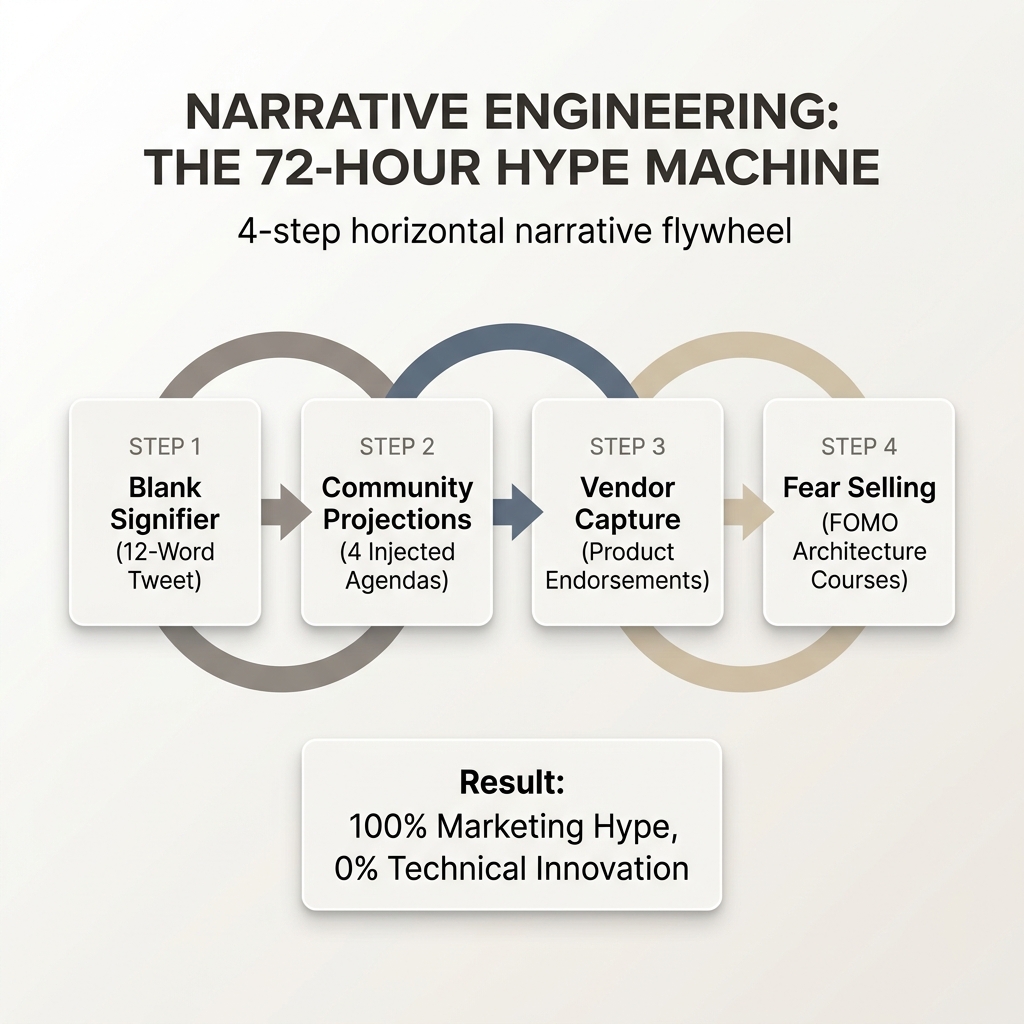
The 72-Hour Narrative Engineering Flywheel of Graph Engineering
Learning Graph Engineering is fundamentally an exercise in deconstructing marketing cycles. It leveraged the low cognitive barrier of geometric graph concepts, used a 12-word tweet with zero spec as a projection screen, and allowed creators, vendors, and educators to build a global buzzword in 72 hours.
Understanding this narrative mechanism equips us to stay clear-headed when the next hype wave arrives.
More importantly, in actual engineering practice, Graph is not a linear “Stage 5 evolution” to be blindly chased. When the marginal cost of code and text generation approaches zero, the bottleneck of Agent systems never lies in the number of nodes, but in three core pillars:
1. **Context Engineering**: Maintaining clean, high-relevance context windows without cluttering prompt space with intermediate noise;
2. **Harness Engineering**: Establishing deterministic tool boundaries, safe sandboxes, and explicit stop conditions to prevent runaways;
3. **Independent Verification**: Decoupling the Maker from the Checker, using deterministic rules or independent Verifiers to evaluate output rather than letting an Agent grade its own homework.
Stripping away marketing spin and focusing on Context governance, Harness constraints, and Verifier evaluation—this is the true engineering leverage that compounds over time.