In the first two pieces of this series, we examined how live-streaming platforms use artificial mechanisms like level badges and blind boxes to induce spending, and how streamers and big spenders negotiate over exclusive attention. Those two articles leaned mostly on platform rules and industry insiders' experience. This piece turns to real data to see whether those rules of thumb actually hold up in practice.
Before collecting our own dataset, we reviewed the published academic literature and found surprisingly little to go on. Traditional Western platforms such as YouTube and Twitch do have large-scale studies tracking over a million hours of VTuber streams, but their monetization works very differently from Chinese platforms: revenue comes mainly from paid highlighted messages (Super Chats) and channel memberships, with no native blind-box gacha or split-screen PK battles. On top of that, large sponsorships for Western streamers often happen off-platform, leaving relatively little high-value data visible on public web pages.
Importing conclusions from those platforms straight into China produces huge distortion. Across the mostly small- and mid-sized Bilibili virtual singing and chat rooms we sampled, Super Chats accounted for just 3.9% of actual spending; more than 96% of revenue came from direct gifts, monthly room memberships (called Captains on Bilibili), and random blind boxes. On the domestic side, there is indeed a massive study of 2.7 million Bilibili live streams, but it scraped only public text chat and gift logs—without recording and transcribing what the streamer actually said into the microphone, there is no way to align spoken interactions with the exact moments viewers open their wallets.
To find out who the big spenders in these rooms really are and what actually makes them pay, we recorded and transcribed more than 1,200 hours of Bilibili virtual singing and chat audio. Combining that audio timeline with over 740,000 room-entry logs and ¥514,000 in actual viewer payments, we used AI to align who walked in, what they talked about, and what triggered each payment. The results were quite surprising: whether a sales funnel really turns casual passersby into big spenders, who the top-ranked patrons actually are in real life, and what moments make viewers spend all looked very different from what we expected.
The Myth of the Conversion Funnel
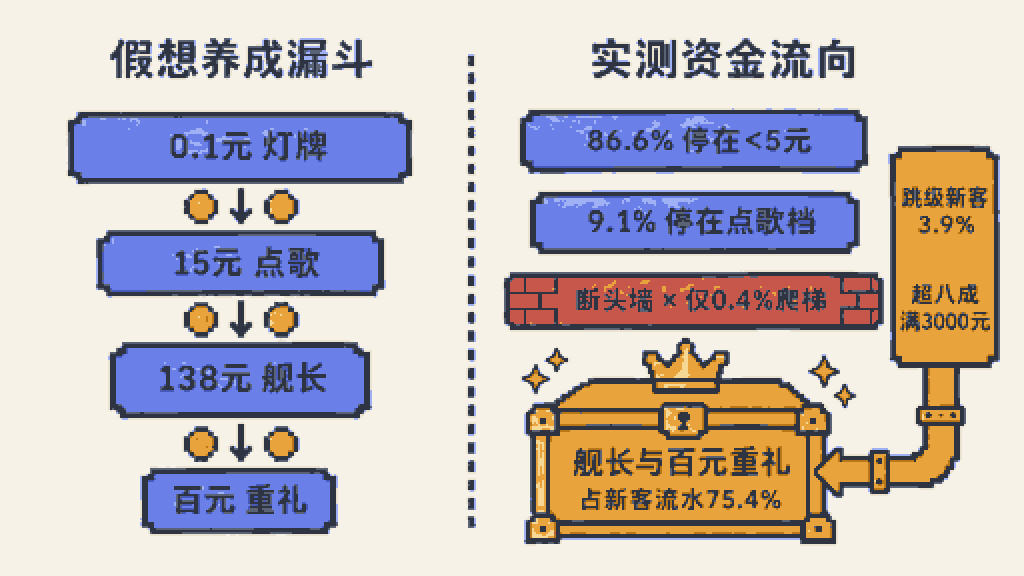
As someone who works in tech, my immediate reaction to a live room's gift menu was: isn't this a textbook conversion funnel? A newcomer pays ¥0.1 to light up a dedicated fan badge (which can later be leveled up with further gifts) and gets a free song request; once they become a regular, they spend ¥15 on a Heartbeat Blind Box to request songs; as trust and attachment build, they upgrade to a ¥138–¥198 monthly Captain subscription; and during 5-minute split-screen gift battles between two streamers (PK), they drop hundreds or thousands of yuan on heavy gifts.
In reality, plenty of new streamers do spend every session begging passersby to light up that ¥0.1 badge, convinced that if you pour enough newcomers into the top of the funnel, some will gradually climb all the way to Captain and #1 on the leaderboard. Put those 740,000+ room-entry logs next to the payment ledger, however, and that assumption falls apart. First comes the massive silent majority beneath the surface: nearly 96% of room entries never type a single word, listening quietly for free and leaving. And when we break down the 10,000+ viewer-room payment records by actual spending role inside a room, headcount and revenue diverge sharply:
| Spending Role Inside the Room | Share of Paying Viewers | Share of Actual Revenue |
|---|---|---|
| Casual passersby spending under ¥15 (badges & small tokens) | 86.5% | 1.1% |
| Regular listeners spending ¥15–¥499 on blind-box requests (non-Captains) | 8.9% | 13.1% |
| Single-month Captain subscribers (under ¥500 total) | 3.3% | 12.7% |
| Core big spenders (¥500+ cumulative in the room) | 1.3% | 73.2% |
Look at the bottom two rows: 73.2% of revenue comes from core big spenders who have spent at least ¥500 in the room, even though they make up just 1.3% of paying viewers. Add single-month Captain subscribers, and together those two groups represent only 4.6% of payers yet generate 85.9% of all cash. That gives us a clean way to test the funnel hypothesis: did this 4.6% of Captains and big spenders who carry the room really climb up step by step from the cheapest ¥0.1 passerby tier?
Filtering out existing room regulars from those 10,000+ payment records, we tracked over 3,600 newly paying viewers—people who had neither leveled up a fan badge nor held a Captain subscription in that room before—and followed their spending over time. Low-tier trials almost never convert upward; they are a dead end for free listeners. Fully 86.6% of newcomers stopped permanently under ¥5 (most paying just ¥0.1 for a badge and a free song), accounting for 1.1% of newcomer revenue; another 9.1% stopped in the ¥5–¥99 song-request tier. Viewers who actually matched the funnel—starting with pocket change, moving on to blind-box requests, and eventually upgrading to a Captain subscription or ¥100+ gifts—made up just 0.4% of newcomers.
In other words, more than 99% of newcomers never walk through the funnel. Together, those first three buckets account for 96.1% of the 3,600+ newcomers; the heavy spending among newcomers comes almost entirely from the remaining 3.9% who skip straight to the top—bypassing small trials on arrival to buy a Captain membership or ¥100+ gifts right away, and single-handedly taking 75.4% of all newcomer revenue. Among those jump-in newcomers whose site-wide Honor Level is visible, over 80% had already spent at least ¥3,000 across Bilibili (Honor Level 25+) before ever setting foot in the room. They may have wandered into this particular room today, but they are not beginners—they completed their spending onboarding long ago in other rooms across the platform. Small and mid-sized live rooms are not factories that incubate spending habits from scratch. A ¥0.1 buyer's ceiling is usually ¥0.1; big revenue comes from retaining mature spenders who are already in the habit of paying across the site.
Even active regulars who send hundreds of messages a night in small rooms do not naturally glide up a spending funnel. Take a young legal professional working at a law firm in Europe who uses the time-zone offset to unwind in late-night Chinese streams after work. After impulsively spending over ¥1,000 before a previous favorite streamer retired, he set a firm rule in his new room: converting euros into RMB to recharge was too bad a deal. Across 11 sessions, he spent just ¥27.6 in small tokens, yet became a core late-night regular on the strength of 400+ chat messages sharing stories from abroad and cheering the streamer up. Another late-night regular tried two ¥15 blind boxes, pulled two ¥9 consolation gifts, complained about the rigged feel, and swore off blind boxes for good. Nearly 90% of his gift clicks stayed at ¥0.1; he only bought a monthly Captain subscription when the streamer sang his free requests two days in a row, or apologized to him by name after teasing him too hard. For level-headed regulars like these, chatting actively already delivers all the companionship they want—they are never going to climb a blind-box and PK ladder into whales.
The Mismatched Identity of the #1 Patron
Since nearly all the big money in live rooms comes from regulars and cross-room veterans wearing high-level badges, it is natural to assume the people camping out at the top of the leaderboard are wealthy bosses throwing money around in real life. After all, in small and mid-sized rooms with fewer than 100 Captains, over 60% of public chat comes from users who have spent at least ¥8,300 site-wide (Honor Level 30+); by contrast, zero-spend passersby write only about 0.5% of chat. Yet the moment we bucket every revenue-generating session by room size and check what it actually costs to be #1 for an evening, half of that billionaire mystique shatters.
| Room Size Tier | Median Session Revenue | Median #1 Patron Spend | Median Top-3 Threshold |
|---|---|---|---|
| Newcomer rooms (<30 Captains) | ¥286 | ¥179 | ¥16 |
| Mid-sized rooms (30–99 Captains) | ¥759 | ¥300 | ¥61 |
| Large rooms (100+ Captains) | ¥1,187 | ¥356 | ¥138 |
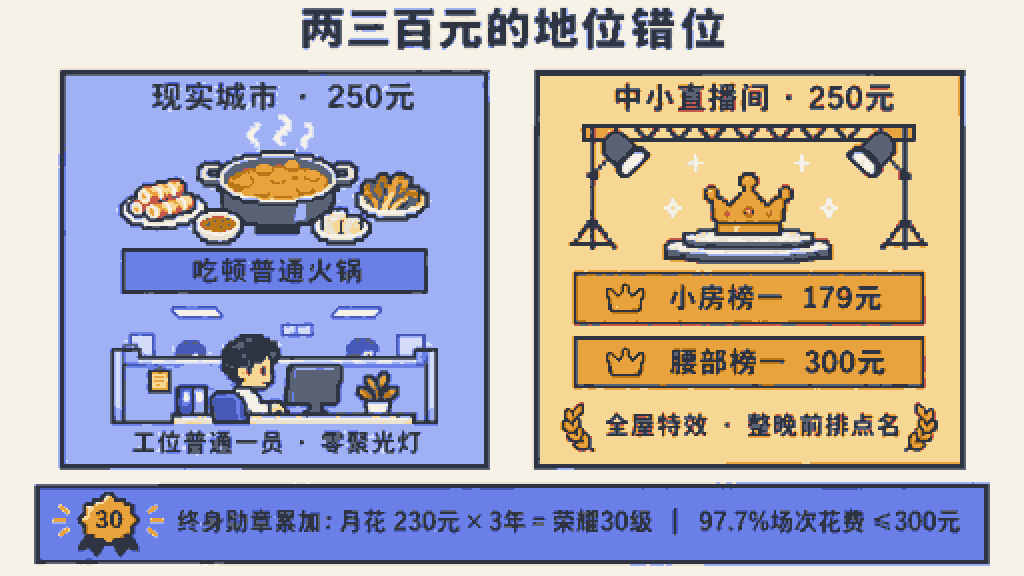
Across all the virtual singing and chat rooms we monitored, the median spend to take #1 for an entire evening was just ¥249 (~\(35), and breaking into the top 3 took a median of ¥59 (~\)8). In a major city, two or three hundred yuan barely covers a decent hotpot dinner with coworkers—and you still have to answer to your boss the next morning. Inside a small or mid-sized live room with a few dozen people online, however, that modest slice of a salaried worker's pocket money is enough to cover more than half the night's revenue, buying a flashy entry banner, a chorus of "generous boss!" in chat, and hours of the streamer riffing directly with you.
Dig into that intimidating-looking Honor Level 30 badge (¥8,300 cumulative spend across Bilibili), and it turns out to be mostly an artifact of time. Under Bilibili's official rules, site-wide Honor Level accumulates for life and never drops. Even if your badge grays out after 7 days without spending, tossing a single ¥0.1 gift lights all the entry effects right back up. An ordinary salaried worker spending roughly ¥230 a month—say, renewing an auto-pay Captain subscription and pulling a couple of blind boxes—will wear an Honor Level 30 badge after three years. Looking across more than 3,000 paid sessions by Honor Level 30–39 regulars (¥8,300 to ¥64,000 lifetime spend), in 97.7% of sessions they spent ¥300 or less for the entire night, with a median single-session spend of just ¥0.2. Most evenings they walk in, drop ten or twenty fen to light up their entry banner and enjoy the room's welcome, and only open their wallets for ¥100–¥200 when a PK battle breaks out or the vibe hits just right. That is strict monthly-allowance budgeting, nothing like throwing money around.
Follow the everyday chatter in public chat, and the real-life demographics come into even sharper focus. Casual visitors who only say hello reveal nothing about their jobs, so we focused on real regulars who had spent at least ¥100 and sent at least 300 chat messages. Among the Honor Level 30–39 backbone, 82.8% casually mentioned being ordinary office workers, shift technicians, or students—and exactly 0 mentioned owning a company, luxury cars, or villas. Even up in Honor Level 40–49 (¥64,000 to ¥330,000 lifetime spend), more than half (56.0%) were white-collar commuters worrying about subways, business trips, and rent, or college students attending classes. Genuinely wealthy players with both time and financial freedom are concentrated at the very tip of the pyramid—Honor Level 50+ (¥330,000+ lifetime spend). One had just stepped off a dozen-hour international flight and, still jet-lagged, hopped into a familiar room after midnight to drop multiple ¥3,000 gifts during double-points windows purely for fun. Another Level 72 veteran (¥5.7 million+ lifetime spend) casually dropped over ¥24,000 in two weeks on a 60-Captain mid-sized streamer, unfazed by losing thousands of yuan in blind boxes in a single night, playing mobile games while bantering with the streamer purely for the relaxed vibe of a small room.
Yet those apex players numbered just 149 people across our entire dataset, generating roughly 30% of total revenue. The remaining 70% of real cash came entirely from viewers below ¥330,000 lifetime spend—propped up primarily by ordinary salaried workers, white-collar employees, and undergraduates or grad students watching quietly in college dorms so they wouldn't wake their roommates.
Within that 70% majority, some are remarkably calculating, deliberately picking tiny rooms where modest budgets stretch into maximum presence. One Honor Level 37 office worker never stays up late and openly jokes that he isn't a real whale. He drops into a room with barely a dozen Captains around 6 a.m., pulls a few small blind boxes so the streamer plays his personal nostalgic playlist in order while he listens and naps, then logs off before 11 a.m. for work. Over 16 days he broke ¥5,300+ into more than 200 small gifts—an amount that wouldn't make a ripple in a large room, yet here made him the #1 backer the streamer checks with before starting a PK battle.
Far more sobering is another group of workers who project real-life squeeze straight into the live room. One young Honor Level 46 office worker living away from home in a major city (¥180,000+ lifetime spend) watched a coworker just a year older buy an apartment with family down-payment help and a 20-year mortgage. Convinced he could never save enough on salary alone, he underreported his income to his parents and lived paycheck to paycheck; even with work the next morning, he stayed up until 4 a.m. in a 60-Captain room and dropped ¥5,400+ in 11 days just to stay near the top of the room's leaderboard and hold the streamer's nightly attention. Another Level 39 worker with only one day off a week rented on the urban fringe with laggy landlord Wi-Fi at a cash-strapped small company that skipped his year-end bonus—yet spent nearly ¥2,900 over 14 days in a 40-Captain room on midnight PK battles. After sending ¥50+ once, he complained in chat that the streamer felt distant just for missing his personal nickname; even after admitting he was out of budget for the month, he couldn't stop sending gifts until the streamer pleaded into the mic for him to rein it in, and before 3 a.m. he sighed in chat that it was too easy to lose control.
The starkest case was an Honor Level 30 regular doing shift-based equipment maintenance in northern China, who once worked 81 days of day-labor gigs and had recently taken a pay cut down to ¥210 a day. On the day his father went to the hospital for chemotherapy, he dropped off his ID card and rushed straight back to his shift for fear of losing wages. Yet inside a tiny 12-Captain room, he spent more than 8 full days of wages over 16 days. Even when recharging triggered WeChat Pay's anti-fraud limit, he split payments into ¥30–¥40 chunks to push nearly ¥500 into a platform lottery event—absorbing over ¥100 in losses just to pull a ¥300 special-effect gift and hold it in reserve. Waiting until the streamer was mid-sentence, he fired it onto the screen just to hear her startled gasp.
Communication scholars have a name for this pattern: compensatory consumption. At an offline dinner table, your clothes, your car, and your job title are immediately visible. Inside a live room, the chat panel flattens all of that away—everyone sees only the badge number beside your name and the gift animation flashing across the screen. True whales do account for roughly 30% of the money, but the everyday traffic and monthly subscriptions keeping most small and mid-sized rooms alive come largely from ordinary commuters and students. They tip not because their bank accounts are overflowing, but because a live room sells a status inversion that real life rarely offers: for two or three hundred yuan of pocket money, you can take off your work badge for two hours after shift and be treated as the guest of honor.
The Actual Moment They Pay
Once you see that most viewers in the room have real budget ceilings and count every hundred yuan carefully (and even apex whales don't spend blindly), it makes sense why they don't walk in and start throwing money at the screen. Aligning 1,200+ hours of streamer transcripts with gift ledgers reveals three distinct stages from walking in, to paying that night, to deciding whether to come back: first there has to be a real conversation, then there has to be a reason to spend, and finally it comes down to whether the viewer genuinely enjoyed chatting that night.
The first link is that conversation almost always precedes payment. Outsiders often picture mysterious whales gliding into a room silently, dropping a pile of gifts, and vanishing. Yet across all 53 single-shot gifts and Super Chats of ¥500 or more in our dataset, exactly 0% were dropped within the first minute of entering, and over 90% of payers had already spoken in chat before opening their wallets. What are they talking about? Looking at chat messages in the 3 minutes before payment, fewer than 7% announce an upcoming gift; nearly 90% are casual banter and jokes with the streamer. When a viewer who hasn't paid yet enters with a lit badge banner or posts their first message of the day, if the streamer calls out their name and picks up the thread within 45 seconds, the odds of a low- or mid-tier viewer spending within the next 5 minutes jump to roughly 3x the rate when the streamer misses the cue. Honor Level 40+ veterans, by contrast, have heard every greeting in the book—a quick hello won't make them pay within 5 minutes; they wait for the right moment later in the session.
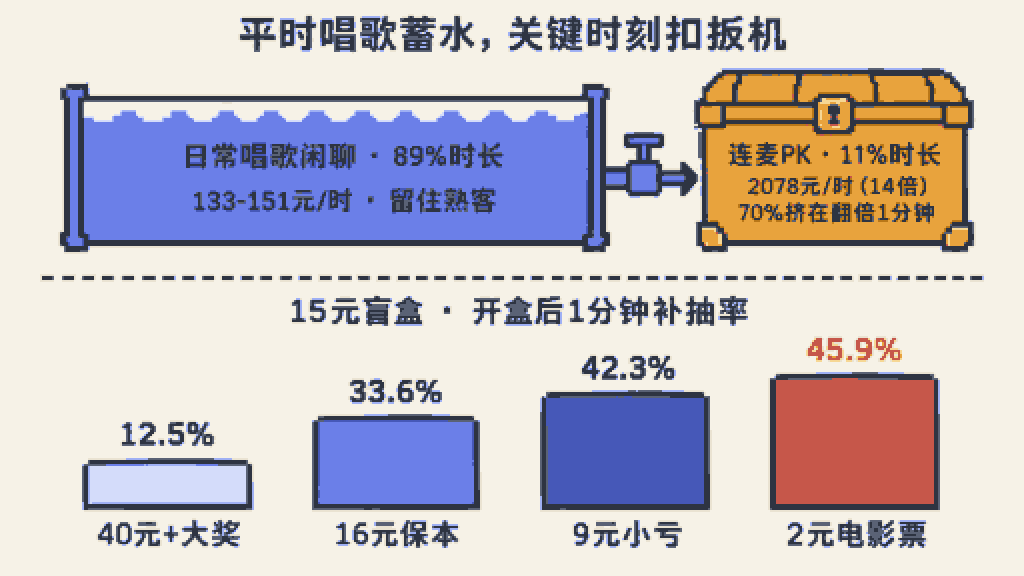
The second link, once the room is warmed up, is giving budget-conscious viewers a compelling reason to pull the trigger tonight. Large rooms with 100+ Captains have waterfall-speed chat, rarely run PK battles, and monetize mainly through Captain renewals and Super Chats. In small and mid-sized singing rooms (<100 Captains) that run PK battles, however, genuine singing, post-song thanks, and between-song banter together take up 89% of airtime—yet each averages just ¥133 to ¥151 per hour. Nearly nine-tenths of the broadcast is really about keeping regulars seated at the table. The instant the room switches into the 11% of airtime devoted to PK battles, hourly revenue spikes to ¥2,078—nearly 14 times the baseline.
Let's look closely at how those 5 minutes of PK actually move money. When a streamer casually asks for song requests between songs, the following 2 minutes bring in an average of roughly ¥4. Switch to rallying votes during a PK battle, and the following 2 minutes jump to an average of ¥175 (over 70% covered by Honor Level 40+ spenders). The red-and-blue progress bar, countdown timer, and 2x-score bargain logic suddenly make a regular who was hesitating over two or three hundred yuan feel like the hero saving the room. And when someone drops a ¥1,000+ gift during a PK push and triggers a site-wide broadcast banner, crowds of curious onlookers really do flood in over the next 3 minutes (averaging ~30 extra entries per banner)—yet those unfamiliar visitors spend a combined average of just ¥4.1 per banner. That echoes earlier field experiments on Chinese showroom live streaming: site-wide banners were never meant to acquire new paying fans for the streamer; their real job is to pull dozens of fresh pairs of eyes into the room right on cue to cash out public prestige for the patron who just paid.
Beyond PK rivalry, everyday song requests hide a second spending trigger: the sting of losing on a ¥15 Heartbeat Blind Box. Every ¥15 pull drops a random gift priced from ¥2 to ¥2,233 straight to the streamer—anything above ¥15 feels like a win with bragging rights, anything below feels like a loss. Across nearly 1,000 independent single pulls, the worse the unboxed item, the harder viewers found it to stop. Even comparing the exact same person against their own prior pulls, their rate of immediately pulling again within 1 minute after hitting the bottom-tier ¥2 Movie Ticket was 23.4 percentage points higher than after breaking even or winning big. Here is the 1-minute re-pull rate across all four outcome tiers:
| Single ¥15 Blind-Box Outcome | Gift Sticker Value | Immediate Re-Pull Rate Within 1 Min |
|---|---|---|
| Jeweled Scepter & higher jackpots | ¥40 to ¥2,233 | 12.5% |
| Heart Pillow (just broke even) | ¥16 | 33.6% |
| Cotton Candy (¥6 loss) | ¥9 | 42.3% |
| Movie Ticket (¥13 loss) | ¥2 | 45.9% |
Once viewers find their reason to pay, the third link happens after the stream wraps up. After a gift lands, does stopping the show to heap praise on the donor for a full minute or two make them more likely to return and spend again? The data says no. Looking strictly at existing room regulars, when a streamer didn't pause for an extended shout-out after a gift, 75.5% returned in a future session; when the streamer stopped to praise them for more than a full minute, the return rate was 69.6%—no lift whatsoever.
We also examined 420 viewers who spent at least ¥15 in their first recorded session: regardless of their Honor Level or how much they spent that night, lavish post-gift flattery failed to increase repeat spending in later sessions. What actually predicts whether someone comes back to spend again is how many chat messages they themselves sent that night. After-the-fact politeness doesn't keep people around; viewers come back only when they genuinely had fun talking in the room.
After combing through more than 1,200 hours of live audio, the mystique surrounding live-stream tipping dissolves. There is no magical funnel turning ten-cent passersby into whales, nor a roomful of effortless billionaires tossing money blindly. What actually holds the ecosystem together is a pool of seasoned spenders circulating across rooms, alongside ordinary people willing to spend two or three hundred yuan after work to buy two hours in the front row. They walk in, test through casual banter that there is a real human on the other side of the screen worth talking to, and when the atmosphere peaks, take the cue handed to them by a double-points countdown or a ¥2 Movie Ticket. Once you see the real budgets in viewers' pockets and the exact moments they decide to spend, all those dazzling badges, blind boxes, and red-and-blue progress bars turn out to be a precision machine built straight along the grain of ordinary human loneliness and competitiveness.